The carpenter
The Painted BirdThe carpenter is a farmer whose fear of lightning turns The unnamed boy narrator’s dark hair into a supposed danger to his household. He responds to storms by sending the boy away from the village, and later, after a barn fire, prepares to drown him. The relationship ends when the boy lures him to a wartime bunker and escapes as The carpenter falls inside and dies. Across these episodes, The carpenter’s superstitions and authority over the boy give way to a desperate contest in which the boy’s survival depends on exploiting what The carpenter wants.
Identity and Beliefs
The carpenter and his wife believe that the boy’s black hair will attract lightning to their farm. Their fear has a physical prompt: when The carpenter touches the boy’s hair with flint or a bone comb on hot, dry nights, small bluish-yellow sparks appear. The couple interpret this as confirmation of danger, rather than as an ordinary effect of friction.
That household belief belongs to a wider village account of storms. Lightning is understood as a fiery force from heaven, and villagers believe that a house struck by it cannot be saved by human effort. They also hold that a strike sinks into the earth and can draw another bolt to the same place seven years later; objects rescued from a lightning-struck house are thought to retain the danger. The carpenter’s fear of the boy is therefore reinforced by a communal system of explanation in which fire is both physically destructive and beyond human control.
Sending the Boy into Storms
When storms approach, The carpenter crosses himself, fastens the boy to a heavy harness with a padlocked chain, and takes him by cart to a distant field. He leaves him away from trees and habitation, knowing that the restraint prevents him from returning to the hut. At dawn, after the storm has passed, The carpenter comes back and takes him home. The practice makes the boy’s isolation a deliberate response to the household’s fear: the boy is not merely kept indoors for safety but removed from the farm as a supposed source of danger.
One stormy afternoon, The carpenter falls ill, and his wife is occupied caring for him. She does not take the boy out of the village as usual. When thunder begins, he hides beneath hay in the barn. The barn catches fire during the storm, and the blaze spreads toward the hut and cow barn. Villagers rush out as animals break loose in the confusion. The account establishes the fire and The carpenter’s absence from his usual routine, but does not establish precisely what ignites the barn or that the boy caused it.
The Sack and the Boy’s Offer
After the boy is found back in the village, The carpenter arrives with his wife. He strikes the boy, takes him to the farm, and leaves him near the burned barn. When the boy regains consciousness, The carpenter is preparing a large sack. The boy remembers that sacks like it had been used to drown sick cats, and pleads for his life; The carpenter continues preparing it without answering.
The boy then recalls that The carpenter had spoken of Partisans concealing wartime trophies and supplies in old bunkers. He offers to show him a pillbox containing old boots, uniforms, and military belts that he found while escaping. The carpenter is interested, although he pretends not to believe the claim. The offer changes the immediate balance between them: instead of relying on an appeal for mercy, the boy gives The carpenter a reason to postpone the planned killing and follow him to the hiding place.
At dawn, The carpenter harnesses an ox to his cart, takes an ax, and sets out with the boy, who is tied by a string to his hand. The boy tries to think of a way to get free, but the string is strong. At the bunker, he delays by acting as though he has forgotten where the entrance is. When they reach it, The carpenter pushes aside the metal cover and leans over the opening, unable at first to see into the darkness. The boy moves to the opposite side, putting the opening between them, and understands that he must act quickly or The carpenter may kill him and throw him inside.
Death and Narrative Significance
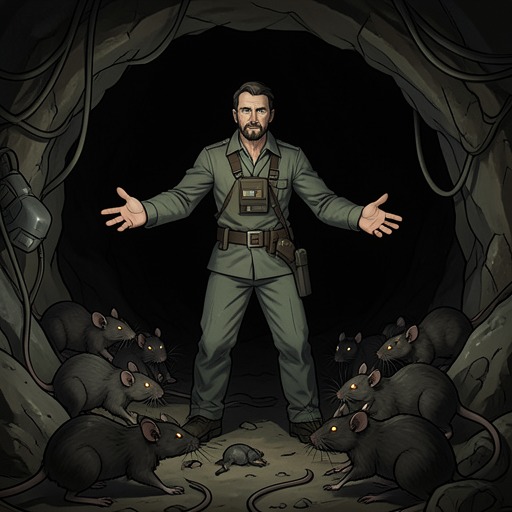
The boy pulls sharply on the string. The movement draws The carpenter forward into the bunker; the string catches against the opening and snaps, leaving the boy free. The carpenter falls out of sight among the rats inside, and the boy watches from above as the animals cover him. The boy does not close the opening. He remains at its edge, unable to look away, before the account describes The carpenter’s body disappearing beneath the rats.
The ending reverses the earlier storm episodes. There, The carpenter uses a chain and cart to remove the boy from danger as he understands it, exercising control over where the boy can go and whether he can return. At the bunker, a string that ties the boy to The carpenter becomes the means of escape, and The carpenter is the one who falls beyond reach. The boy’s offer of hidden wartime goods is not a reconciliation: it is a survival tactic that brings The carpenter to the place where the power between them abruptly changes. The carpenter’s fear of forces he believes human beings cannot master thus concludes in an encounter with a danger he has chosen to approach, while the boy survives by acting within the narrow opening the pursuit gives him.